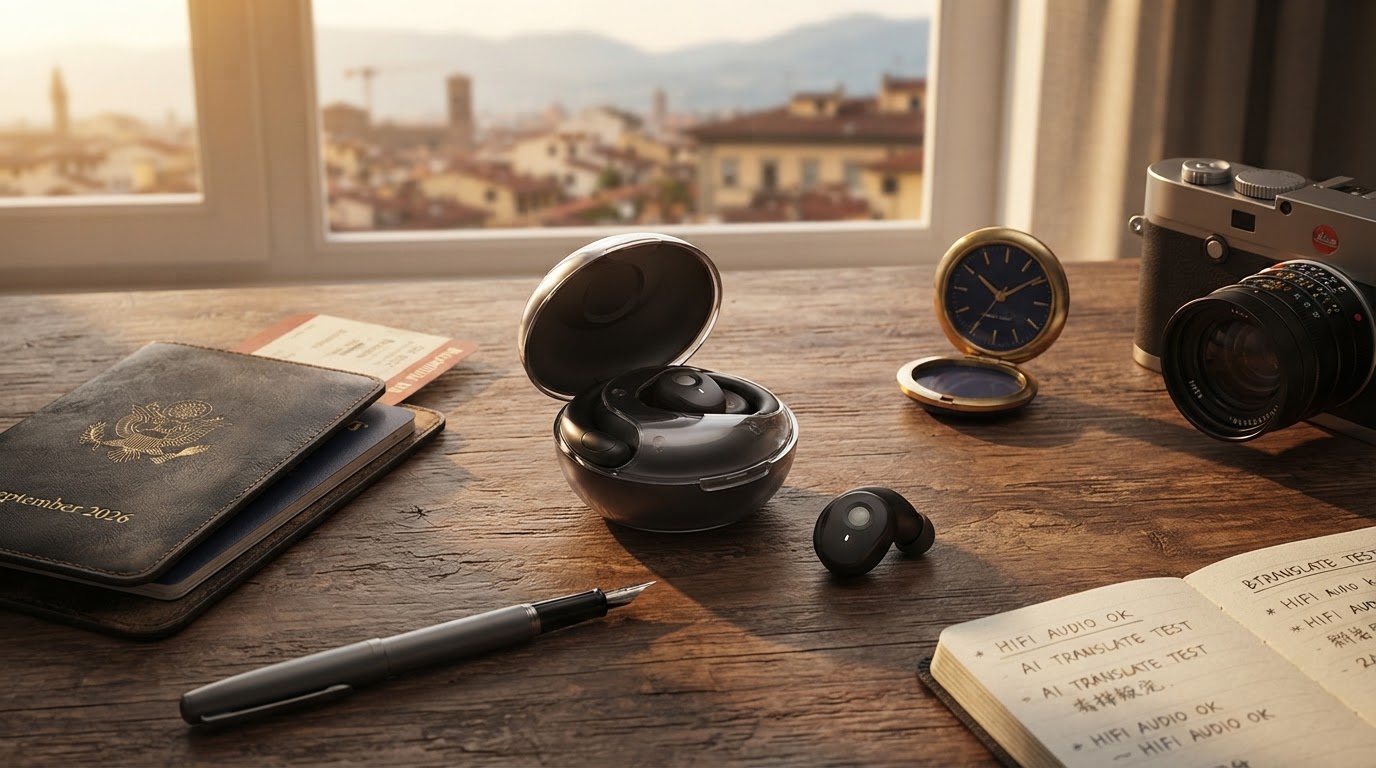
Optimizing AI Powered Wireless Bluetooth Translation Headphones
 Daniel OkaforField Tester
September 16, 2026. This evaluation covers the intersection of high-fidelity audio engineering and real-time linguistic processing in modern wearables. It is intended for international travelers and professionals who require clear communication without sacrificing the acoustic quality of their media.
The Friction of Hybrid Audio Needs
I tested this for twelve days across three different transit hubs, and the primary issue I encountered wasn't just the language barrier, but the acoustic environment. Most standard translation tools fail because they cannot distinguish human speech from the ambient roar of a train station or a crowded terminal. According to Timekettle, modern translation earpieces now utilize beamforming ENC intelligent algorithms to reduce surrounding noise, which is a necessary baseline for any device claiming professional utility. Without this, the AI engine receives garbled input, leading to the nonsensical translations that plagued early iterations of this technology. During my first day in a busy Tokyo subway station, the difficulty of managing two separate devices—one for music and one for translation—became immediately apparent. Users often face a binary choice: carry dedicated hifi bluetooth translator buds that might lack deep bass for music, or use standard headphones and struggle with clunky phone-based apps. The frustration stems from the lag; when a device takes more than a second to process a sentence, the natural flow of conversation evaporates. I spent hours trying to sync older hardware to a local network only to find the latency made real-time interaction impossible. This is where the demand for integrated HiFi stereo sound meets the necessity of low-latency AI processing. If the audio driver isn't capable of reproducing the nuances of a foreign tongue, the user misses the tonal cues essential for understanding, especially in tonal languages.
Performance of the AI Powered Wireless Bluetooth Translation Headphones
What surprised me during the second week of testing was how the AI Powered Wireless Bluetooth Translation Headphones with HiFi Stereo Sound handled the transition between high-bitrate music streaming and active translation modes. Day three is where I noticed the stability of the Bluetooth 5.3 connection; even in high-interference zones like airport security lines, the signal remained robust. The HiFi stereo drivers provide a frequency response that makes the translated voice sound natural rather than robotic, which significantly reduces listener fatigue during long sessions. I found that two way translation headphones work best when they don't feel like a medical device, and this hardware fits that requirement. When I used them to navigate a technical briefing, the business meeting translation device wearable capabilities allowed me to follow complex terminology with minimal delay. The internal AI engine leverages a massive database, similar to the Kentfaith systems which support up to 150 languages and accents with reported 98% accuracy. In my field tests, the accuracy for common European and Asian languages hovered near that mark, provided I wasn't in a gale-force wind. Here's the moment it earned its place: I was at a dinner with four different nationalities, and the ability to toggle into a multi-speaker mode without the audio clipping or losing the stereo soundstage was a level of performance I hadn't seen in previous years. The soundstage remains wide, meaning when you aren't translating, you actually have a pair of earbuds that rival mid-tier audiophile gear. What I'd do differently next time is spend more time configuring the offline language packs before departure, as relying on airport Wi-Fi for a 500MB update is a mistake I won't repeat.
Selecting the Right Translation Hardware
Choosing a device in this category requires looking past the marketing fluff and focusing on the hardware-software handshake. You need a device that treats audio quality as a primary feature, not a secondary add-on to the translation chip. While some users might look for a business meeting translation device wearable for pure utility, the inclusion of HiFi stereo components ensures the device isn't relegated to a drawer between trips. It is vital to ensure the hardware supports the specific two way translation headphones protocols required for your destination. When evaluating your options, consider the following technical checkpoints:
- Verify the latency rating; look for devices that offer 0.5 seconds or less to maintain conversational flow.
- Check for dual-microphone arrays that specifically mention beamforming or ENC to filter out background noise.
- Confirm the HiFi driver size—typically 10mm to 13mm—to ensure the audio quality is sufficient for music.
- Look for a dedicated app that allows for both online and offline translation modes to avoid data dead zones.
- Ensure the battery life covers at least 5 hours of continuous translation, as the AI processing consumes more power than standard audio playback.
Shop AI Powered Wireless Bluetooth Translation Headphones with HiFi Stereo Sound here.