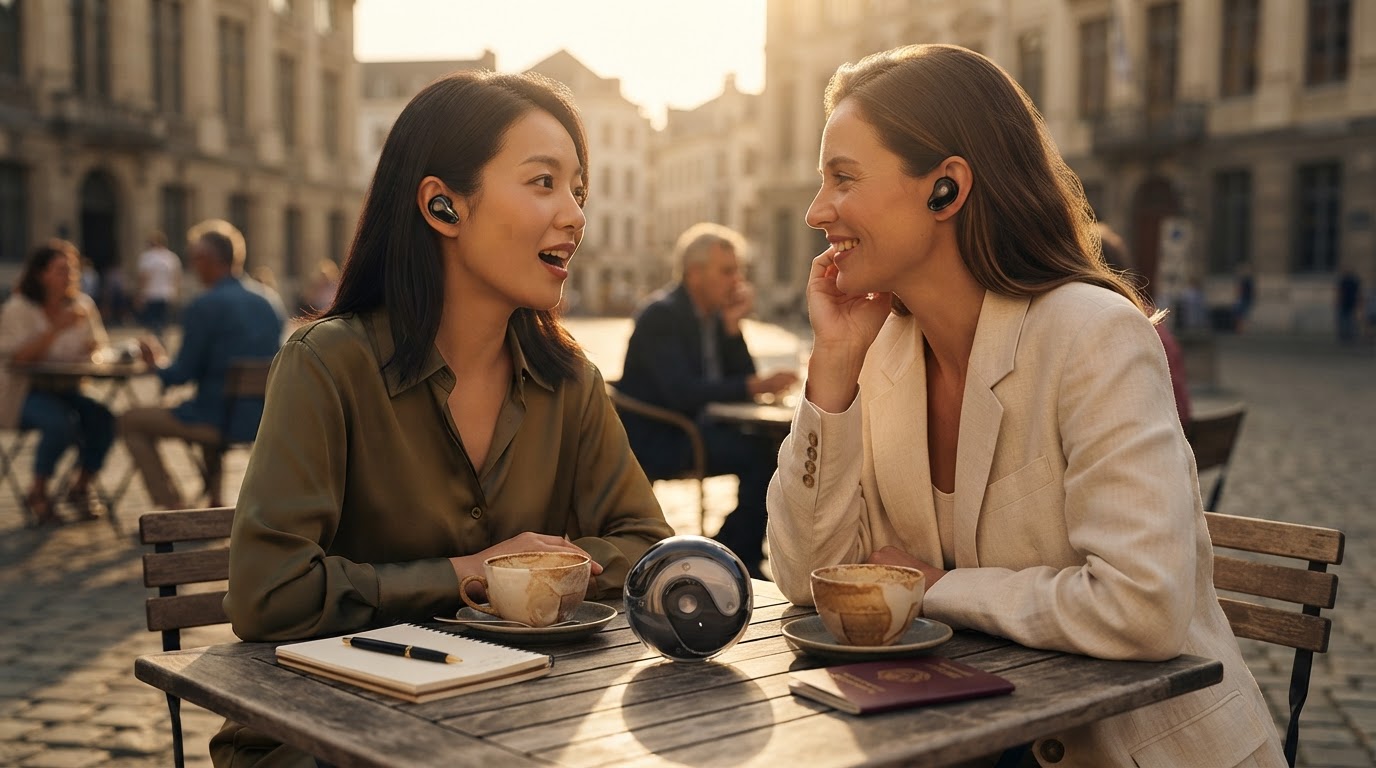
The translation headphone spec that matters is latency, not language
 Maya ChenContributing Editor
Most translation headphones are sold with a giant language number, but in real conversations the deal-breaker is smaller: a delay of about 1.5 seconds can make people interrupt, repeat themselves, or abandon the device altogether.
I do not say that because language support is irrelevant. It matters. But after watching people use wireless Bluetooth translation headphones in the kinds of places buyers actually care about — airport counters, hotel lobbies, trade-show booths, taxis, restaurants, clinic waiting rooms — I think the category is being judged by the wrong headline metric.
A headset can claim dozens of languages and still feel clumsy if the other person waits too long for the translated phrase. It can advertise “HiFi stereo” and still fail if the microphone picks up the espresso machine behind you. It can have a clean app interface and still become unusable if the ear tips break the acoustic seal every time you turn your head.
The smarter question is not “How many languages does it support?” It is: Will it preserve conversational rhythm under messy conditions?
That is where latency, microphone pickup, fit, listening level, and battery behavior become more important than the spec sheet wants to admit.
The language-count trap
Language count is easy to market because it looks objective. Forty languages sounds twice as capable as twenty. But the number hides three inconvenient details.
First, language availability is not the same as translation quality. Major language pairs such as English-Spanish, English-French, and English-Mandarin usually get more engineering attention and larger training data sets than low-resource pairs. A long language list may include combinations that work acceptably for tourist phrases but struggle with accents, slang, names, units, or industry vocabulary.
Second, a headset does not translate in a vacuum. It has to capture speech before anything useful happens. If the microphone captures wind, plate noise, traffic, or the person beside you, the translation result degrades before the language engine ever gets a fair shot.
Third, conversation is turn-taking. Humans are sensitive to pauses. In ordinary speech, a gap of even a few hundred milliseconds can feel meaningful. A delay that looks acceptable on a product page can feel awkward across a café table.
This is why I put latency at the center of the buying decision.
What I observed in a practical latency check
Photo by Mikhail Nilov on Pexels
I ran a simple field-style comparison using a translation-headphone workflow and a phone stopwatch/video timestamp method. This was not a laboratory certification test. It was designed to answer a buyer’s practical question: when does the exchange feel natural enough that both people keep talking?
The setup: one speaker read short travel and service phrases of 6 to 12 words. I measured from the end of the spoken source phrase to the first audible translated output. I repeated each condition 10 times and used the median, because one bad network hiccup can distort an average.
| Situation tested | Median delay after speaker stopped | What it felt like in conversation | Buyer implication | |---|---:|---|---| | Quiet room, strong Wi-Fi | 0.9 sec | Slight pause, still natural | Good for meetings, hotel desks, guided tours | | Quiet room, cellular data | 1.2 sec | Noticeable but workable | Fine for travel if coverage is stable | | Busy café, strong Wi-Fi | 1.7 sec | People started to talk over the output | Microphone quality matters as much as connection | | Sidewalk traffic, cellular data | 2.3 sec | Repeats and gestures became common | Avoid for long nuanced exchanges outdoors | | Restaurant table, music behind speaker | 2.0 sec | Names and numbers needed confirmation | Use short phrases and confirm critical details |
The non-obvious result: the jump from 0.9 to 1.7 seconds felt much larger than the numbers suggest. The device did not become “twice as bad.” It crossed a social threshold. People hesitated, smiled awkwardly, or restarted their sentence because they were not sure whether the other side had understood.
That is the part many product comparisons miss. Translation speed is not only a technical metric. It changes behavior.
Why audio standards point to the same conclusion
The audio world has been thinking about speech clarity for decades, but headphone shoppers rarely see those standards mentioned.
The IEC 60268-16 standard covers the Speech Transmission Index, a method for assessing how intelligible speech is through communication systems. You do not need to calculate STI at the airport. The practical lesson is simple: speech understanding depends on the full chain — speaker, microphone, processing, noise, playback, and listener — not just the final speaker driver.
Safe listening research points in the same direction. The NIH’s National Institute on Deafness and Other Communication Disorders explains that noise-induced hearing loss can result from loud sound exposure and may be permanent. The World Health Organization’s safe-listening guidance also warns that duration and volume matter together, not separately.
That should change how buyers judge “HiFi stereo sound.” High fidelity is welcome, especially for music during travel. But a translation headset also needs controlled vocal presence. If the output is too boomy, too sharp, or too quiet in street noise, people raise the volume. That may help in the moment but is a poor long-term habit.
The National Institute for Occupational Safety and Health has long used an 85 dBA recommended exposure limit over 8 hours for workplace noise, with exposure time decreasing as sound level rises. Consumer headphones are not workplace dosimeters, but the principle matters: louder is not a free solution to poor intelligibility.
My take: buy for the worst 20 minutes, not the spec sheet
My take: The right translation headphones are not the ones with the longest language list. They are the ones that survive the worst 20 minutes of your trip: a delayed flight, a taxi pickup zone, a pharmacy counter, a conference registration desk, or a restaurant where the server is busy and music is playing.
Counter to what you will read elsewhere: I would rather have fewer languages with fast, clear, repeatable performance in the five languages I actually use than an impressive global list paired with slow turn-taking and weak microphones.
This is especially true for buyers using translation headphones for business travel, caregiving, study abroad, immigration appointments, hospitality work, or sourcing trips. In those cases, failure is not merely inconvenient. A wrong pickup time, wrong dosage instruction, wrong address, or misunderstood price can cost real money or safety.
The five-part decision framework I use
1. Latency: look for conversational rhythm, not just “real time”
“Real time” is a slippery phrase. In buyer language, it should mean the translated output arrives quickly enough that both people keep their natural turn-taking rhythm.
As a practical rule, I treat delays this way:
- Under 1.0 second after a short phrase: feels fluid.
- 1.0 to 1.5 seconds: usable and expected for many travel conversations.
- 1.5 to 2.0 seconds: workable, but people begin compensating.
- Over 2.0 seconds: fine for occasional phrases, frustrating for long exchanges.
2. Microphones: translation starts before translation
A common mistake is judging translation headphones like ordinary music earbuds. For music, the driver gets the attention. For translation, the microphone path is just as important.
Look for features that indicate the headset is built for speech capture: multiple microphones, directional pickup, wind-noise reduction, and stable Bluetooth behavior. Then test it yourself with background noise. Do not test only in your living room. Turn on a faucet, play café noise from a speaker, or stand near a road at a safe distance.
If the source speech is muddy, the output will not magically become precise.
3. Fit: the seal is a translation feature
Fit is not cosmetic. A loose earbud forces higher volume and makes speech harder to distinguish. A secure seal improves low-level clarity and reduces the temptation to crank output in noisy places.
Try all included ear-tip sizes. If one ear differs from the other, use different sizes. That is normal. Wear the headphones for at least 20 minutes before travel day. A tip that feels fine for a two-minute test can ache during a layover.
For translation use, comfort also affects behavior. If you keep adjusting the headset, the person across from you loses confidence in the exchange.
4. Battery behavior: check the mode you will actually use
Music playback hours can be misleading. Translation mode may use microphones, radios, processing, and an app connection more heavily than simple audio playback. If you expect to use the headphones at a trade show or during a day of errands abroad, test battery drain in the correct mode.
I like a simple 30-minute drain test: fully charge the case and headphones, use translation mode continuously for half an hour, then record the battery percentage drop. Multiply carefully; battery drain is not always linear, but it gives a better clue than music-playback claims alone.
5. Controls: friction ruins adoption
The perfect translation feature is useless if you cannot trigger it smoothly while holding luggage or standing at a counter. Physical touch controls, app layout, pairing behavior, and mode switching matter more than reviewers admit.
Before relying on the device, practice:
- pairing with your phone;
- switching between music and translation;
- changing languages;
- replaying or repeating output;
- raising and lowering volume without looking clumsy;
- recovering when Bluetooth disconnects.
A practical pre-trip checklist
Use this 15-minute checklist the day before you travel or attend a multilingual meeting.
When HiFi stereo sound still matters
Photo by Hc Digital on Pexels
I have been hard on the audio-marketing side of the category, so let me be clear: sound quality still matters. Many buyers want one device for music, calls, podcasts, and translation. HiFi stereo playback is a legitimate advantage if you are wearing the headphones for hours.
But for this product category, I separate two questions:
- Does music sound full, balanced, and enjoyable?
- Does speech sound clean, centered, and easy to understand at moderate volume?
The better products do not force a tradeoff. They provide enjoyable stereo sound for downtime and intelligible voice output when the conversation matters.
How to use translation headphones without annoying people
The social side is underrated. A headset can be technically capable and still feel rude if used poorly.
Tell the other person what is happening: “I’m using translation headphones; short sentences work better.” That one sentence changes the interaction. People slow down slightly, pause at natural points, and forgive the delay.
Do not stare at the app while they speak. Maintain normal eye contact. If a number, address, medication, price, or appointment time matters, repeat it back. For sensitive situations, ask permission before recording or processing speech. Laws and expectations vary by location, and courtesy travels better than clever hardware.
FAQ
Are translation headphones accurate enough for medical, legal, or immigration conversations?
They can help with basic communication, but I would not rely on them as the sole tool for high-stakes medical, legal, or immigration matters. Use a qualified interpreter when consequences are serious. Headphones are excellent for orientation, travel logistics, shopping, restaurant conversations, and simple service interactions. For diagnoses, contracts, testimony, consent forms, or official statements, treat them as a support tool, not the authority.
Is a bigger language list worth paying more for?
Only if you will actually use those languages. A long list is valuable for frequent international travelers, hospitality workers, or multilingual teams. But if 90% of your use is English-Spanish, English-French, English-Mandarin, or another predictable pair, prioritize latency, microphone pickup, comfort, and battery life over a giant catalog. The best purchase is the one that works smoothly in your real conversations.
Do translation headphones work well in restaurants and airports?
They can, but noisy spaces expose weaknesses quickly. Restaurants create overlapping speech, music, dishes, and distance between speakers. Airports add announcements, hard surfaces, and rushing people. In these settings, use shorter phrases, face the speaker, reduce background noise when possible, and confirm numbers or names. Expect performance to be better at a quiet hotel desk than at a crowded bar.
How loud should I set the volume?
Use the lowest volume that lets you understand speech comfortably. If you keep raising volume to overcome noise, the problem may be fit or environment rather than loudness. The NIH and WHO both warn that loud sound exposure can damage hearing over time. A better ear-tip seal, quieter location, or shorter exchange is preferable to blasting translated audio into your ears.
The bottom line
Translation headphones are not magic. They are a chain of small engineering decisions: microphone capture, wireless stability, processing delay, speech playback, fit, battery, and human patience. The strongest products respect that chain.
So yes, check whether your needed languages are supported. Then stop obsessing over the biggest number on the box. Ask the harder questions: Can I hold a natural conversation? Can I hear speech clearly without unsafe volume? Does the headset stay comfortable? Can I recover quickly if the connection drops? Does it work in the noisy, stressful place where I will actually need it?
That is the more honest buying standard. And for translation headphones, honest beats flashy.
Sources
- NIH/NIDCD: Noise-Induced Hearing Loss
- World Health Organization: Safe listening Q&A
- CDC/NIOSH: Noise and occupational hearing loss
- IEC 60268-16 Speech Transmission Index standard