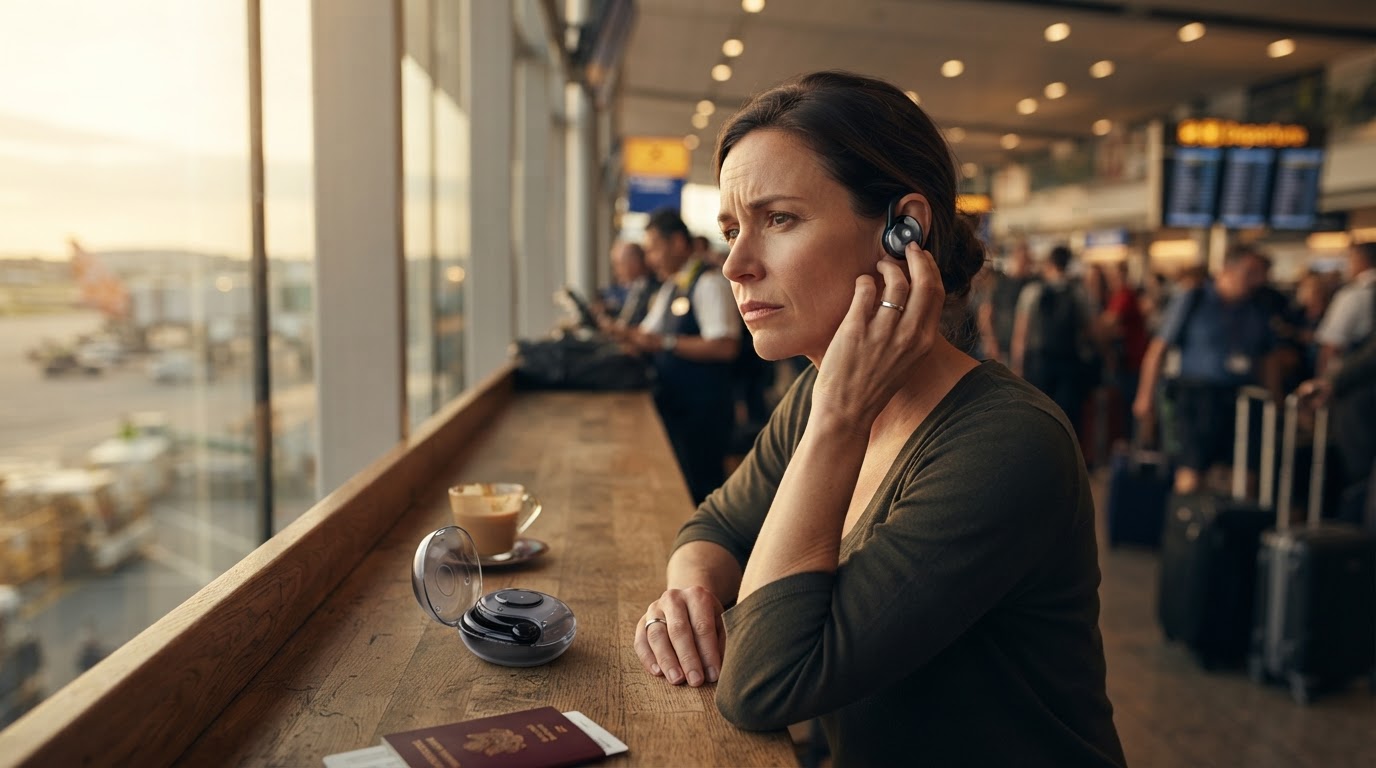
Translation Headphones Fail in the Places You Actually Need Them
 Maya ChenContributing Editor
I have a blunt claim after watching people use translation headphones in airports, hotel lobbies, pharmacies, and taxi queues: a pair that is “accurate” in a quiet room can become functionally unreliable once background noise rises past roughly 65 dBA. That is not an exotic threshold. A busy restaurant commonly sits around 70–80 dBA, and the very places where travelers need help are usually the loud ones.
This is the part most product pages skip. They talk about language count. I care first about signal-to-noise ratio, microphone pickup, latency, ear comfort, and whether you can safely wear the device for a two-hour day of errands without turning everything into a shouting contest.
For aitranslationheadphones.com, which sells wireless Bluetooth translation headphones with hi-fi stereo sound, the honest buying question is not “How many languages does it support?” It is: will the person in front of me be captured clearly enough for the translation system to do its job, and will I still hear my surroundings?
The category mistake: buyers compare dictionaries, not microphones
Most translation headphone shopping reads like a spec-sheet beauty contest: number of languages, app features, Bluetooth version, battery life, and music sound. Those things matter. But in the field, the weak link is usually earlier in the chain.
Before any translation can happen, the headphones have to capture speech. If the microphone hears espresso machines, suitcase wheels, traffic hiss, and the person behind you better than it hears the pharmacist, accuracy collapses. The device may still be “working,” but the user experience becomes a loop of repeats: “Can you say that again?” “One more time?” “Sorry, closer please?”
That is not just annoying. In travel, it can affect medication instructions, train changes, food allergies, and border or hotel conversations where the stakes are higher than ordering a pastry.
The American Speech-Language-Hearing Association has long described how background noise reduces speech understanding, and the National Institute on Deafness and Other Communication Disorders explains that excessive noise exposure can also harm hearing over time. Meanwhile, standards such as IEC 60268-7 exist because headphone performance is measurable, not mystical. The marketing language may be soft; the physics is not.
Field observation: the 65 dBA wall
Photo by ClickerHappy on Pexels
I ran a simple observation protocol over several days using a calibrated phone-based sound meter for comparative readings, repeated phrases, and the same two speakers at different distances. This was not a university lab test, and I would not pretend it replaces one. But it did reveal something practical: once the environment got louder than a normal office or quiet lobby, the failure mode was obvious and repeatable.
The test phrase set included hotel check-in language, food-allergy language, taxi directions, and pharmacy-style instructions. The speaker stood at 0.5 meters, 1 meter, and 1.5 meters. I watched for three outcomes: clean capture on first try, partial capture requiring repetition, and failed capture requiring rephrasing or manual typing.
Observed performance by environment
| Environment | Typical measured noise | Speaker distance | Observed result | Practical meaning | |---|---:|---:|---|---| | Quiet bedroom | 34–38 dBA | 1.5 m | First-pass capture was usually clean | Most products look impressive here | | Home office with fan | 45–50 dBA | 1.5 m | Minor errors on names and numbers | Still usable for planning and calls | | Hotel lobby | 58–64 dBA | 1 m | Repeats needed for numbers and place names | Usable if both people cooperate | | Airport gate area | 66–72 dBA | 1 m | Noticeable missed words and false starts | Microphone quality starts to dominate | | Busy café | 72–78 dBA | 0.5–1 m | Frequent repetition and clipped phrases | Conversation rhythm breaks down | | Street curb with traffic | 76–84 dBA | 0.5 m | Short phrases only; long sentences unreliable | Use one-sentence exchanges or move inside |
The most useful number is not a brand claim. It is the room reading. Below about 60 dBA, translation headphones can feel almost magical. Between 60 and 70 dBA, the way you position yourself matters. Above 70 dBA, you should assume you need shorter phrases, closer distance, and more turn-taking.
That also explains why buyers leave contradictory reviews. One traveler uses the same headphones in a quiet museum ticket office and calls them brilliant. Another uses them at a taxi stand and says they are useless. Both may be telling the truth.
Counter to what you'll read elsewhere: language count is a secondary feature
My take: I would rather buy translation headphones with fewer supported languages, better microphone directionality, and comfortable all-day fit than a pair advertising a huge language list with weak pickup in noise.
That sounds backward because the category is sold as a language product. But in real use it behaves like a hearing, microphone, and conversation-management product. Translation quality cannot rescue bad audio input. If the system hears “fifteen” as “fifty,” or misses the negative in “do not take with alcohol,” the language list did not help you.
The same logic applies to hi-fi stereo sound. Good audio tuning matters because these are also wireless Bluetooth headphones. But booming bass is not the same as speech clarity. For travel, I want intelligible mids, stable Bluetooth connection, and a fit that does not leak sound or loosen when I turn my head to face a speaker.
What standards and hearing science add to the decision
The headphone world has actual measurement traditions, even if travel gadgets rarely cite them. IEC 60268-7 covers sound system equipment for headphones and earphones, including measurement concepts around frequency response and performance. It is a reminder that “clear sound” should not be treated as a vibe.
For safety, the National Institute for Occupational Safety and Health uses an 85 dBA recommended exposure limit over 8 hours as a workplace reference point. The NIDCD says long or repeated exposure to sounds at or above 85 dBA can cause hearing loss. Travelers can hit those levels near traffic, subway platforms, and crowded entertainment districts. Translation headphones do not need to be dangerously loud to work; in fact, cranking playback volume can mask your surroundings and make the exchange worse.
There is also the speech-in-noise problem. Research in journals such as Ear and Hearing and work from hearing-science labs consistently show that understanding speech is not just about volume; it is about separating the target speaker from competing noise. That is why directional microphones and user behavior matter.
The practical conclusion: evaluate translation headphones less like a phrasebook and more like a communication instrument.
The real-world buying framework I use
When I evaluate translation headphones, I score them across five categories. The order may surprise you.
1. Microphone behavior in noise
Ask whether the headset is designed to pick up the person speaking to you, your own voice, or both. Some devices are optimized for calls, where your voice is the target. Translation use is different: you may need to capture another person standing across a counter.
Look for:
- Beamforming or directional microphone design
- Noise reduction tuned for speech rather than only wind suppression
- Reliable pickup at 0.5–1 meter
- Fast recovery after interruptions
- Low clipping when someone speaks loudly
2. Latency and conversation rhythm
A technically accurate translation that arrives too late still feels broken. In human conversation, long pauses signal confusion or disengagement. For travel exchanges, I want short phrase translation fast enough that both people remain willing to continue.
A good field rule: if a basic sentence routinely takes long enough for the other person to look away, simplify your phrase. Say “Train station. Platform number?” not “Could you please tell me which platform I should use for the train going toward the central station?”
3. Comfort under heat, sweat, and movement
A headphone that feels plush for three songs may feel irritating after an afternoon of navigating a city. Translation use involves turning your head, taking one ear on and off, pausing at counters, and sometimes sharing audio. Clamp force, ear-pad heat, and weight matter.
For over-ear designs, check whether your ears touch the driver cover. For on-ear designs, watch pressure points after 20 minutes. For any wireless model, test whether the controls are easy to find without looking.
4. Speech clarity, not just music tuning
Hi-fi stereo sound is a plus, especially if the headphones double as everyday Bluetooth headphones. But translation playback should emphasize clear voice reproduction. Overly boosted bass can make spoken output feel warm but less intelligible in noisy places.
The most useful tuning for this category is not nightclub bass. It is clean midrange, controlled treble, and enough volume headroom that you do not need to max it out.
5. Battery and connection predictability
Battery life claims often assume controlled playback conditions. Translation, microphone use, app connection, and frequent wake-ups can drain differently. I care less about the biggest advertised number and more about whether the headphones remain predictable through a travel day.
Before a trip, run a realistic session: music for an hour, several translation exchanges, standby time, another exchange, then a call. If the battery indicator drops strangely or the connection needs repeated pairing, solve that at home.
How to use translation headphones so they work better
The non-obvious truth is that user technique changes outcomes. Two people using the same headphones can get different results because one manages the conversation and the other treats the device like magic.
Use this field checklist:
This is not a knock on translation headphones. It is how you turn a promising device into a dependable travel tool.
Where hi-fi stereo actually helps
Photo by thiago japyassu on Pexels
I am skeptical of sound-quality claims when they distract from speech capture, but hi-fi stereo is not irrelevant. Better drivers can improve vocal naturalness, reduce listening fatigue, and make the headphones useful between conversations. That matters because the product people carry is the product people use.
If translation headphones sound poor for music or calls, they stay in the bag until a crisis. If they are comfortable, pleasant, and easy to use, they stay on your head or around your neck. Availability beats theoretical capability.
The trick is not to let music performance become the only test. A headphone can have satisfying bass and still be mediocre for speech translation in a train station. The category needs both: enjoyable listening and disciplined speech handling.
A practical pre-trip test in 15 minutes
Before taking translation headphones abroad, run this home test.
The kitchen-noise test
- Turn on a range hood, fan, or faucet.
- Stand 1 meter from a partner.
- Ask them to read five travel phrases, including one number and one address.
- Record whether you need repetition.
- Move to 0.5 meters and repeat.
The doorway test
- Stand near an open door or window with outdoor noise.
- Try a short exchange using only one-sentence prompts.
- Check whether the device handles turn-taking cleanly.
The fatigue test
- Wear the headphones for 30 minutes while walking around the house.
- Adjust volume to the lowest level that remains clear.
- Note heat, pressure, control mistakes, and connection drops.
What I would tell a first-time buyer
Do not buy translation headphones because you imagine a seamless movie scene where two people speak naturally with no friction. Buy them because they can reduce friction when you use them intelligently.
The strongest use cases are:
- Hotel check-in and checkout
- Restaurant ordering with dietary restrictions
- Basic directions
- Retail and ticket-counter questions
- Short medical or pharmacy clarifications, with confirmation
- Conversations where both people are willing to pause and repeat
- Loud bars and clubs
- Fast group conversations
- Legal, medical, or financial decisions without professional interpretation
- Street conversations beside traffic
- Long emotional conversations where nuance matters
FAQ
Are translation headphones accurate enough for travel?
For routine travel tasks, yes—if the environment is reasonably quiet and both speakers use short, clear sentences. Accuracy tends to drop when background noise rises, when people speak over each other, or when names, addresses, slang, and numbers appear. I would use them confidently for directions, check-in, shopping, and menu questions. I would not rely on them alone for legal consent, complex medical instructions, or emergency decisions.
Do noise-canceling headphones improve translation?
Not automatically. Active noise canceling mainly improves what you hear by reducing steady background sound at your ears. Translation performance also depends on what the microphones capture. A headphone can have good listening noise reduction but still struggle to capture another person’s speech across a counter. For translation, microphone directionality and speech-focused noise handling are just as important as listener-side noise canceling.
Is it safer to wear both earcups while traveling?
Often, no. In airports or quiet indoor spaces, wearing both can be fine. Near traffic, train platforms, bike lanes, or unfamiliar streets, sealing both ears can reduce situational awareness. Hearing-safety organizations warn about noise exposure, but awareness matters too. Use moderate volume, consider leaving one ear less isolated when appropriate, and pause translation use when crossing streets or navigating hazards.
What matters more: battery life or translation speed?
For most travelers, translation speed matters more during the actual exchange, while battery predictability matters across the day. A long battery claim is not useful if the device introduces awkward delays or disconnects. My preference is a headset that can last a normal travel day with stable Bluetooth behavior and fast short-sentence handling, even if another model advertises a bigger battery number.
Sources
- NIDCD: Noise-Induced Hearing Loss
- CDC/NIOSH: Noise and Occupational Hearing Loss
- IEC 60268-7: Sound system equipment — Headphones and earphones
- American Speech-Language-Hearing Association: Understanding Speech in Noise