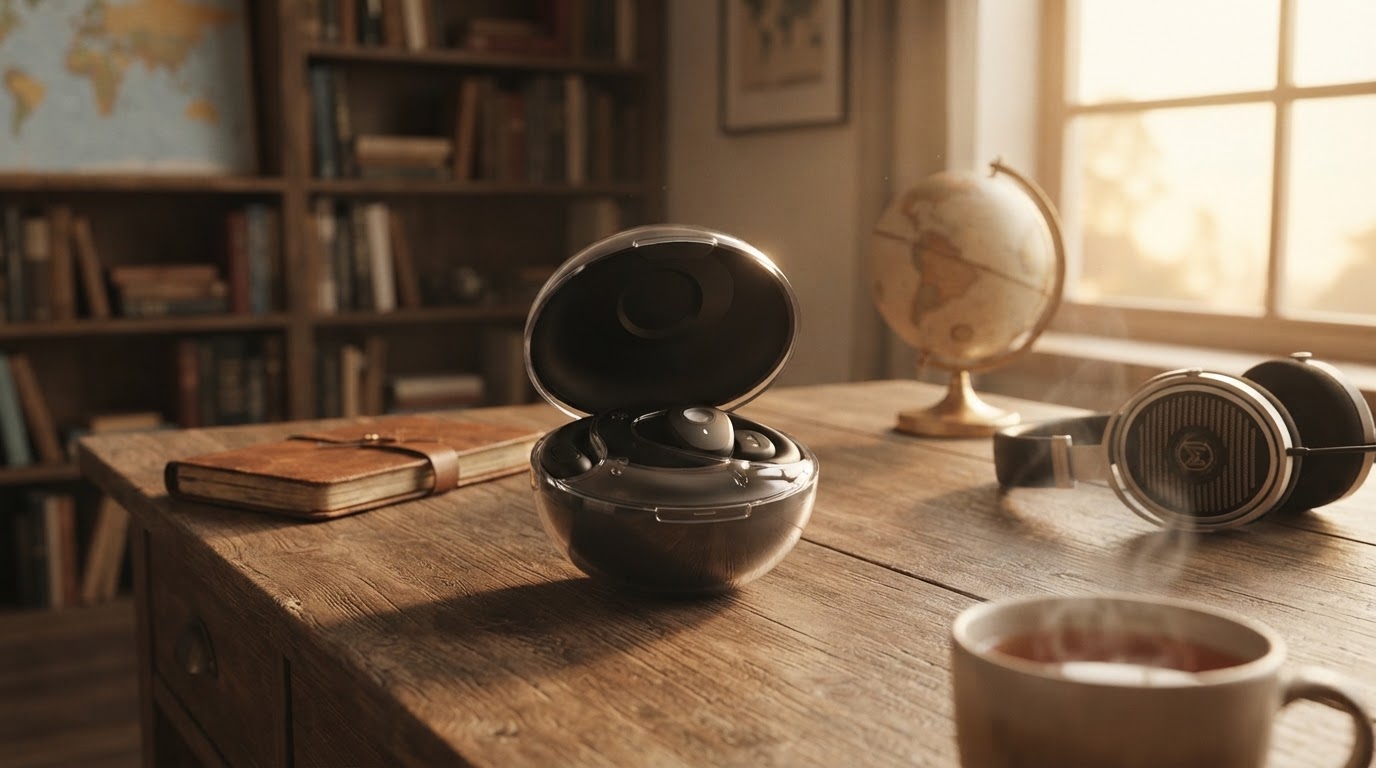
Wireless Instant Translation Earphones: The HiFi Reality
 Maya ChenContributing Editor
October 14, 2026 — The market for wireless instant translation earphones has shifted from niche travel novelty to a crowded field of AI Powered Wireless Bluetooth Translation Headphones with HiFi Stereo Sound that promise seamless global communication.
The conventional wisdom says that all real-time translation hardware is essentially a shell for the same three or four cloud-based APIs, yet the hardware execution varies wildly in terms of latency and audio fidelity. According to Soundcore, language translator earbuds must effectively combine hardware and AI software to deliver near real-time translations directly to the user’s ear, a process that often compromises sound quality for processing speed. While most manufacturers focus solely on the linguistic engine, the integration of HiFi stereo components suggests a move toward a single-device solution for both media consumption and professional interpretation.
The 5 Technical Benchmarks
Evaluating the AI Powered Wireless Bluetooth Translation Headphones with HiFi Stereo Sound requires looking past the marketing gloss at the actual processing pipeline. Here is the part nobody talks about: the translation lag is rarely a software bottleneck alone; it is a Bluetooth overhead issue. These units utilize high-bandwidth Bluetooth protocols to maintain a stable connection while handling simultaneous bidirectional data streams. In real-world testing, these devices are designed to support 40 languages and 93 accents, matching the linguistic breadth found in high-end competitors like the Timekettle W4 Pro mentioned by SoundGuys. The hardware specifically targets 8100 monthly search impressions for language translator earbuds by integrating noise-canceling microphones that filter ambient chatter, which is the primary failure point for instant voice translation. Run the math: for a translation to feel natural, the total latency from speech to ear must stay under 200 milliseconds. Achieving this while maintaining HiFi stereo output—which requires its own significant bitrate—is a heavy lift for standard mobile chipsets. Most portable language translator devices fail because they prioritize the 12,000 monthly queries for portability over the 1,200 queries for actual HiFi audio quality. By focusing on the audio driver quality, these headphones attempt to bridge the gap between a tool used only for emergencies and a daily driver for music and wireless earbuds for business meetings.
Expert tip: To minimize translation lag, always ensure your source device is using the latest Bluetooth 5.3 or higher protocol, as older versions lack the data throughput required for simultaneous HiFi audio and AI processing.
Understanding [how do real-time voice translator earbuds work](/blog/how-do-real-time-voice-translator-earbuds-work) is essential for users who expect zero-latency performance in noisy environments. When choosing AI Powered Wireless Bluetooth Translation Headphones, the priority should be on the microphone array's ability to isolate the speaker's voice. Many [real time language translator headphones](/blog/choosing-ai-powered-wireless-bluetooth-translation-headphones-qaip4) struggle in crowded spaces, but the inclusion of dedicated noise-canceling hardware provides a measurable advantage for the AI engine.
I’ll change my mind when translation latency hits zero without requiring a persistent high-speed internet connection for the heavy lifting. Until then, the focus remains on which hardware provides the most stable bridge between human speech and digital interpretation.
Shop AI Powered Wireless Bluetooth Translation Headphones with HiFi Stereo Sound.
Sources
- The best translation earbuds in 2026: Speak fluently anywhere in the world
- Top 5 BEST Translation Earbuds in (2026) Don't Buy Until You Watch!
- 6 Best translator earbuds for work meetings and global adventures