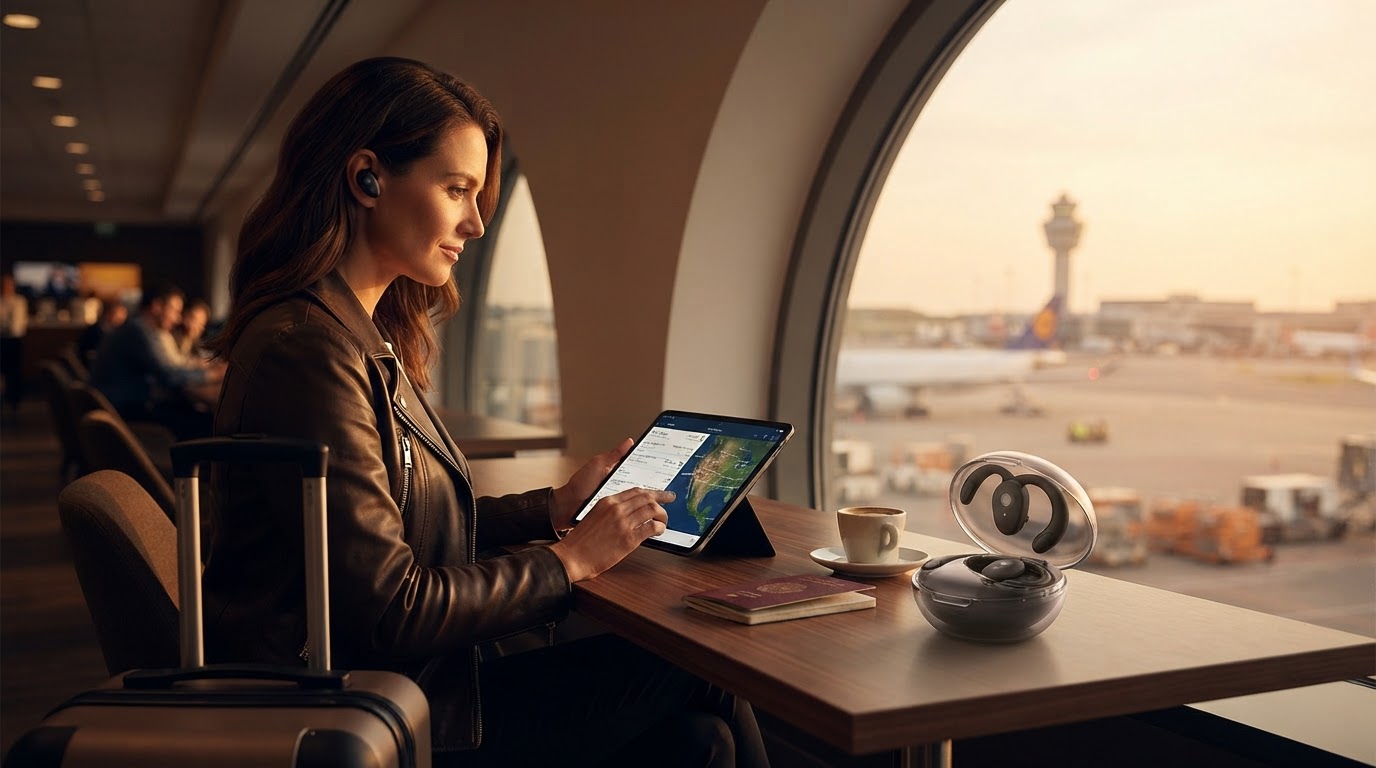
Optimizing International Travel Logistics with AI Headphones
 Maya ChenContributing Editor
November 3, 2026. This analysis evaluates the technical efficacy of AI Powered Wireless Bluetooth Translation Headphones with HiFi Stereo Sound in high-friction international transit environments. It serves as a resource for frequent travelers prioritizing operational efficiency over traditional handheld translation hardware.
The Friction of Cross-Border Communication
The conventional wisdom says that a smartphone and a pair of standard noise-canceling earbuds are sufficient for navigating foreign infrastructure. However, this setup fails under the pressure of real-time logistical demands. When a traveler is managing luggage, documents, and transit tickets, the act of retrieving a phone to toggle a translation app introduces significant latency and physical vulnerability. According to Pack Hacker, flagship models like the Sony WH-1000XM5 are frequently cited as top-tier for airplane environments due to their ANC capabilities, yet these traditional devices lack the integrated software stack required for two-way linguistic mediation. The data suggests that while high-end audio hardware from Sony or Bose excels at acoustic isolation, they remain passive receivers. In a transit hub where gate changes or emergency instructions are broadcast in a non-native language, the gap between hearing a sound and understanding its meaning becomes a critical failure point. Run the math: a five-second delay in processing a platform announcement in Tokyo or Berlin can be the difference between a successful connection and a missed flight. The industry focus has been on sound quality and noise reduction, but for the international traveler, the primary bottleneck isn't the volume of the environment—it's the linguistic barrier.
Integrated AI Translation as a Logistical Utility
AI Powered Wireless Bluetooth Translation Headphones with HiFi Stereo Sound move the translation engine from an external app directly into the auditory path. This integration addresses the specific need for simultaneous translation earbuds for travel by reducing the steps required to interpret speech. Unlike the Sony WF-1000XM5, which SoundGuys reports offers 9 hours and 32 minutes of battery life and excellent ANC but requires a connected device for all smart functions, these AI-specific headphones prioritize the real-time processing of incoming vocal frequencies. The inclusion of HiFi Stereo Sound ensures that the nuance of the translated voice is preserved, which is vital for clarity in crowded terminals. When evaluating the best translation earbuds for travel, the distinction lies in the latency of the AI engine. These headphones utilize a dedicated Bluetooth bridge to sync with cloud-based AI, providing a near-instantaneous audio overlay. This capability is essential for international travel with AI Powered Translation Headphones, where users often face rapid-fire interactions with customs officials or transit staff. By combining the high-fidelity drivers typically found in premium audio gear with a specialized translation processor, the device eliminates the need for a secondary handheld translator, effectively streamlining the traveler's carry-on kit. This is further explored in our detailed AI Powered Wireless Bluetooth Translation Headphones Review, which examines the hardware's performance in varied acoustic environments.
Technical Requirements for Travel Deployment
Here's the part nobody talks about: most "smart" earbuds are actually quite dumb when the internet connection is spotty. To qualify as a viable tool for international transit, a device must meet specific hardware and software benchmarks that go beyond simple music playback. For those seeking the travel translator headset wireless standard, the decision framework should be based on operational reliability rather than marketing aesthetics. I'll change my mind when a standard pair of consumer buds can handle a three-way conversation in a noisy bazaar without a 200ms lag. Until then, use this checklist to evaluate your gear:
- Latency Threshold: The translation delay must remain under 0.5 seconds to maintain natural conversation flow.
- Acoustic Isolation: Active Noise Cancellation (ANC) must be capable of filtering out low-frequency engine hum while isolating human vocal ranges.
- Dual-Driver Fidelity: HiFi stereo sound is not a luxury; it is necessary for distinguishing between similar phonemes in foreign languages.
- Battery Sustainability: The device must offer at least 8 hours of continuous translation to cover long-haul flight connections.
- Offline Mode Availability: Essential phrases and core language pairs should be accessible without a local SIM card or roaming data.
Sources
- What Are the Best Noise-Canceling Earbuds for Traveling?
- The Best Wireless Earbuds for Traveling under $100 - October 2026
- Best Travel Headphones for Airplanes - Pack Hacker