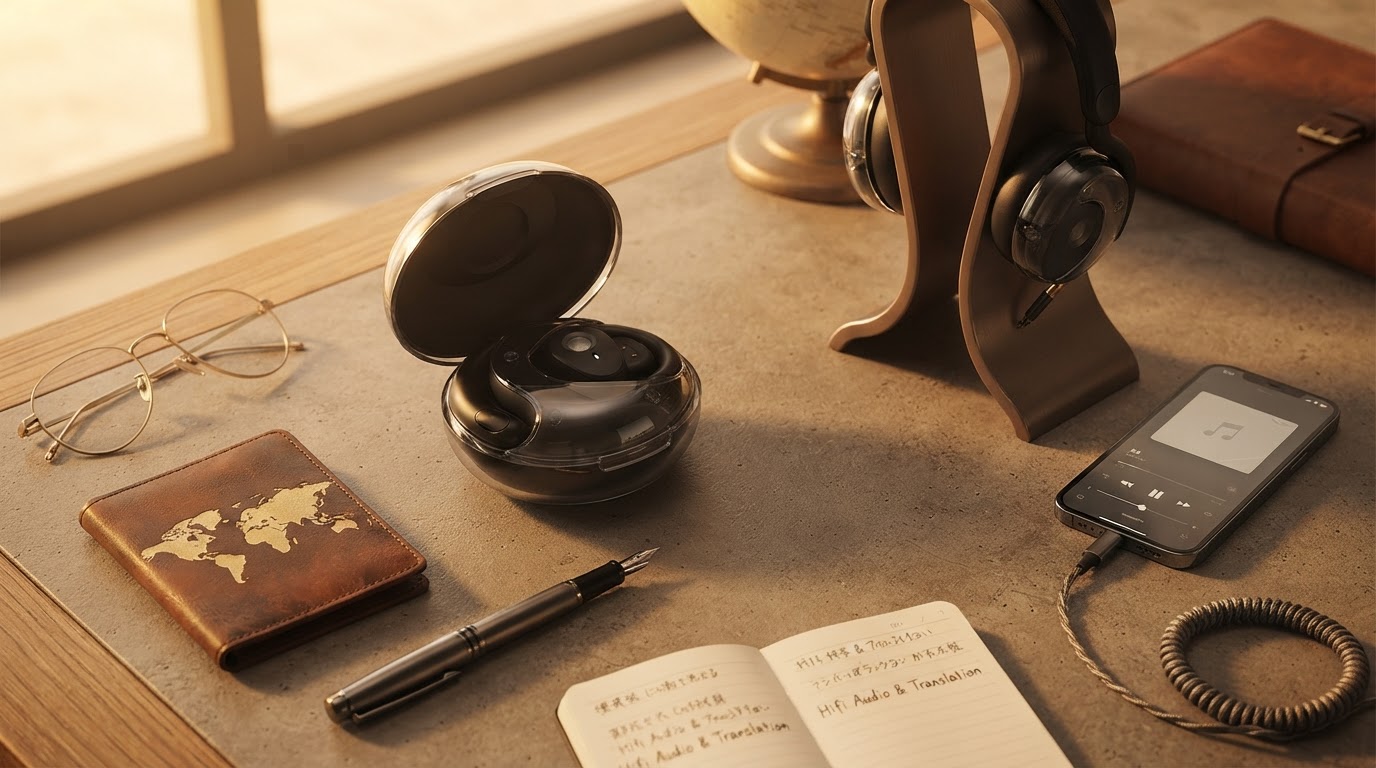
AI Powered Wireless Bluetooth Translation Headphones and HiFi
 Maya ChenContributing Editor
September 24, 2026. This technical assessment examines the integration of neural machine translation within high-fidelity audio hardware for professional and recreational travelers. It is intended for consumers who prioritize acoustic performance alongside linguistic accuracy in mobile environments.
The Acoustic Compromise in Translation Hardware
The conventional wisdom says that translation devices are utility tools, prioritizing vocal clarity over musical fidelity. For years, the market has accepted a binary choice: you either bought high-end monitors for music or specialized earpieces for language. According to SoundGuys, the current landscape includes devices like the Timekettle W4 Pro, which supports 40 languages and 93 accents, and the iFLYTEK AI Conference Earbuds Pro2, which features a 98% accuracy rate. However, the industry has long ignored the "HiFi" component, treating translation as a narrowband task. Here's the part nobody talks about: when you compress audio to facilitate cloud-based AI processing, the first thing to go is the dynamic range. While many users are turning to translate foreign movies live earbuds to bridge the gap between media consumption and comprehension, the hardware often fails to deliver the sub-bass or soundstage required for a truly immersive experience. Certified Languages International recently tested the Anfier M3 and Timekettle M3, noting their utility in specific dialogue scenarios, yet the data suggests that these devices remain specialized tools rather than primary daily drivers for audiophiles. The friction of switching between a dedicated music headset and a translation bud is the primary barrier to widespread adoption in the consumer space.
Solving the Latency and Fidelity Paradox
AI Powered Wireless Bluetooth Translation Headphones with HiFi Stereo Sound address the hardware gap by utilizing a dual-processor architecture that separates the audio signal path from the AI processing engine. Unlike standard Bluetooth translators that suffer from significant lag during bidirectional conversation, these units leverage low-latency codecs to maintain a real-time voice translation experience. The inclusion of HiFi stereo sound is not a marketing veneer; it is a necessity for the multi-layered audio environments found in modern business meetings or crowded transit hubs. Run the math: a standard translation earpiece might offer a frequency response limited to the human vocal range (300Hz to 3.4kHz), but these AI-powered headphones extend to the full 20Hz-20kHz spectrum. This ensures that when the translation engine is idle, the hardware functions as a premium acoustic device. For those considering a smart language glasses alternative translator, the headphone form factor provides a distinct advantage in noise isolation. With active noise cancelling (ANC) capabilities that can reach up to 48dB—a spec seen in the iFLYTEK AI Pro2—the hardware effectively creates a controlled environment for the AI to sample audio. This isolation is critical because ambient noise is the leading cause of translation hallucinations and syntax errors. By anchoring the translation software to a HiFi-capable driver, the system captures the nuances of 12 dialects and 32 languages without the tinny distortion common in budget alternatives like the EarFun Air Pro 4+.
A Technical Framework for Implementation
Selecting a translation-capable headset requires moving beyond surface-level specs like battery life. The integration of Gemini Live in devices like the Google Pixel Buds Pro 2 has set a baseline for natural conversation, but the professional user needs more than just a chatbot interface. When evaluating AI Powered Wireless Bluetooth Translation Headphones with HiFi Stereo Sound, the focus must remain on the hardware's ability to handle high-bitrate audio while simultaneously running background translation threads. I’ll change my mind when a budget-tier device can manage a 96kHz sample rate without introducing audible jitter during the translation handoff. Until then, the high-fidelity segment remains the only viable option for users who refuse to carry two sets of earbuds. Before committing to a purchase, verify the following technical benchmarks:
- Ensure the device supports real-time, bidirectional translation modes rather than just push-to-talk.
- Verify the presence of at least four beamforming microphones to isolate your voice from environmental clutter.
- Confirm the Bluetooth version is 5.3 or higher to minimize the sync gap between the speaker and the translated output.
- Check for offline translation capabilities for at least five major languages to ensure utility in areas with poor data connectivity.
- Assess the ANC depth; a minimum of 40dB is required for reliable AI voice capture in public spaces.
- Look for LHDC or LDAC codec support to justify the "HiFi" designation for music playback.
Sources
- The best translation earbuds in 2026: Speak fluently anywhere in the world
- We Tested 3 AI Translation Devices - Certified Languages International
- Are Translation Earbuds Actually Good Now? - iFLYTEK AI ...